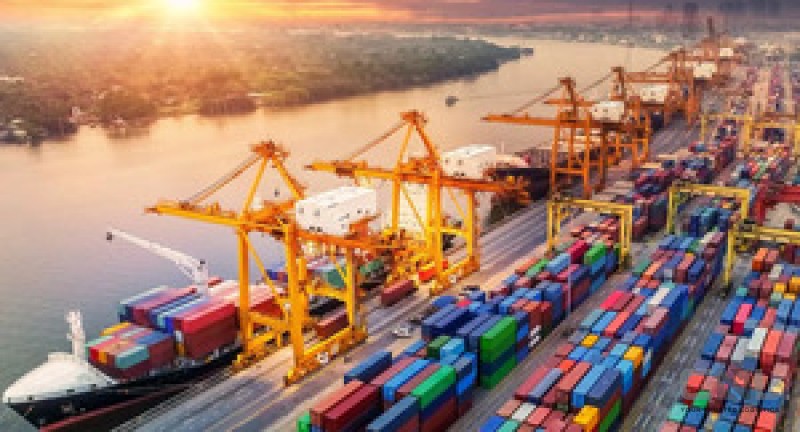
Global shipping growth at risk from economic gloom, UNCTAD says

Global shipping growth at risk from economic gloom, UNCTAD says

LONDON: The pace of global shipping activity is set to lose steam next year as economic turmoil, conflict in Ukraine and the impact of the pandemic weaken the outlook for trade, U.N. agency UNCTAD said on Tuesday.

The world's largest investment banks expect global economic growth to slow further in 2023 following a year roiled by Russia's invasion of Ukraine soaring inflation.

This compares with estimated growth of 3.2% in 2021 and overall shipment volume of 11 billion tonnes, versus a 3.8% decline in 2020.

For the overall 2023-2027 period, growth is predicted at an annual average of 2.1%, a slower rate than the previous three-decade average of 3.3%, UNCTAD said, adding that "downside risks are weighing heavily on this forecast".

"The recovery in maritime transport and logistics is now at risk from the war in Ukraine, the continued grip of the pandem ..

 
Ý kiến bạn đọc
Chủ đề liên quan
Có thể bạn sẽ quan tâm

Automated palletising system stream lines process

Tectra Automation has successfully designed, supplied, installed and commissioned a turnkey solution that has simplified the palletising process while increasing...

Global 3PL logistics growth rate reaches 9%

The global third-party logistics (3PL) market size is expected to grow from $900 billion (2021) to $990 billion this year at a 9.4% CAGR, according to Business Research Company.

What is FCL/LCL?

An FCL/LCL contract is a mode of shipment by ocean freight, also called “pier/house”. The charger takes the packages in a container and delivers a cargo which is destined for several different recipients. On arrival to the port destination, the packages are separated. They are then put at the disposal of the different recipients or delivered to them.

Hai Phong - regional logistics service center - Last post: Human resource development levers

Hai Phong has been offering breakthrough policies and solutions, capturing new ideas to further promote advantages, enhance the role of logistics services in the economic structure of the city, strengthen connectivity and create diffusion in the region. However, human resources for this industry are still modest, requiring a sustainable development strategy.

Regional linkages to enhance the value of Vietnamese goods in the supply chain

The logistics service chain linking product consumption and distribution is a bottleneck, hindering the growth of the southern key economic region.

ProPak Vietnam, Vietwater expos open in HCM City

The 15th Việt Nam International Processing and Packaging Exhibition (ProPak Vietnam) and the 13th Việt Nam International Water Supply, Sanitation, Water Resources and Purification Exhibition (Vietwater) opened on November 9 at the Sài Gòn Exhibition and Convention Centre.

Import and export of goods in 2022 may exceed 700 billion USD

The latest statistics of the General Department of Customs show that, by the end of 11 months, the scale of import and export turnover of goods reached approximately 674 billion USD.

By 2025, the ICD could handle up to 8.7 million tons of cargo.

By 2025, develop a dry port system capable of approving about 20% - 30% of the demand for import and export container transport with a total capacity of about 6 - 8.7 million Teu / year.

Development of logistics centers in Lao Cai to promote import and export

On November 22, in Lao Cai city, the Vietnam Trade Promotion Agency, the Ministry of Industry and Trade and the Department of Industry and Trade of Lao Cai province jointly organized a workshop on promoting import and export activities, promoting the role of Lao Cai on the Kunming - Lao Cai - Hanoi - Hai Phong - Quang Ninh economic corridor.

Reduce logistics costs, increase import and export capacity

The Vietnam Association of Logistics Service Enterprises (VLA) has just reported on logistics activities in Vietnam, in which it is worth noting that logistics costs are equivalent to about 20-22% of annual GDP, significantly higher than Thailand (19%), China (18%), Malaysia (13%) and nearly three times higher than countries such as the US, Singapore (8%).